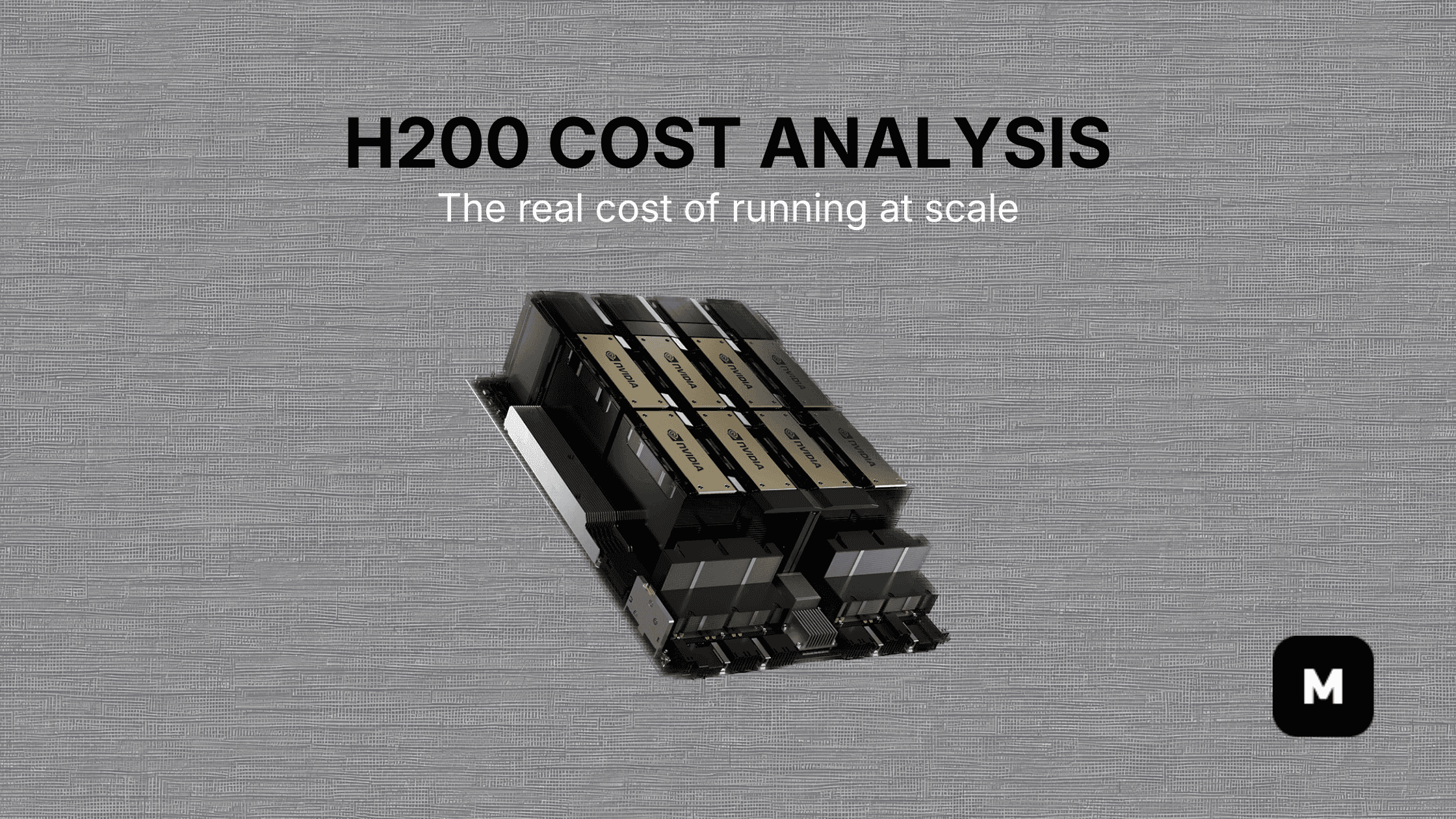
The NVIDIA H200 launched in 2024 and reached broader availability through 2025. By 2026, it’s priced predictably: a 25–30% premium over H100 for 76% more memory and 43% more memory bandwidth.
This guide is the pricing reference. Single-card cost, server-system cost, cloud rental rates across providers, and the supporting cost components that determine your real-world per-GPU-hour spend.
For the comparison framework — when H200 is worth the premium vs H100 or A100 — see A100 vs H100 vs H200 and H100 vs H200: Is the Upgrade Worth It?
H200 OEM pricing (2026)
Three ways to acquire H200 hardware, each with different price points:
| Acquisition path | Price (2026) | Per-GPU equivalent |
|---|---|---|
| Single H200 SXM5 GPU (rare standalone) | $32,000 – $40,000 | $32K – $40K |
| 8-GPU HGX H200 server (Supermicro, Dell, HPE) | $320,000 – $420,000 | $40K – $52.5K |
| H200 PCIe single card | $28,000 – $34,000 | $28K – $34K |
The relevant number for most institutional buyers is the 8-GPU HGX system: ~$370,000 typical, ~$46,000 per GPU including server, NVLink fabric, NICs, and integration.
Why the H200 system price is higher per-GPU than the standalone:
- Server hardware (CPUs, motherboard, chassis): ~$30K
- NVLink fabric / NVSwitch: ~$15K
- Networking and storage: ~$20–30K
- Integration, BIOS, vendor support: ~$10–15K
- Margin: included in OEM price
You can build a less expensive 8-GPU H200 system by going whitebox, but most institutional buyers go OEM for support reasons. For a single H200 in a developer workstation, the PCIe variant at $28K–34K is the practical option.
Why OEM prices vary 25%
Same H200 SXM5, same NVIDIA wholesale price to OEMs — yet different list prices across vendors. The breakdown:
- Volume tier — 100-system orders 8–12% cheaper than single-system quotes
- Region — EU/APAC pricing 5–10% above US (import duties + logistics)
- OEM choice — Supermicro consistently cheapest; Dell and HPE charge premiums for support tiers
- Service level — Basic vs gold-tier support adds 8–15%
For high-volume orders direct with NVIDIA partners, prices can be 15–20% below typical OEM list. This matters for buyers acquiring 50+ systems.
H200 cloud pricing (2026)
A snapshot of H200 cloud pricing on Mercatus GPU Index in May 2026:
| Provider tier | On-demand $/hr | Reserved 1yr $/hr | Reserved 3yr $/hr |
|---|---|---|---|
| Hyperscalers (AWS, Azure, GCP) | $4.50 – $7.00 | $3.50 – $5.50 | $2.80 – $4.20 |
| Tier-1 specialty (CoreWeave, Lambda) | $3.50 – $4.50 | $2.80 – $3.80 | $2.20 – $3.00 |
| Long-tail and regional | $2.50 – $3.50 | $2.00 – $2.80 | $1.80 – $2.50 |
The spread between hyperscaler on-demand and long-tail providers for the same H200 SKU is 2.8× — even larger than the H100 spread. Why? H200 is newer, supply is tighter, and hyperscalers are charging scarcity premiums on top of their normal markup. The long-tail providers that have managed to acquire H200 inventory are pricing more aggressively to gain market share.
The implication for buyers: shopping providers matters even more for H200 than for H100. The savings between hyperscaler on-demand and long-tail reserved capacity for H200 can exceed $4/hour — over $35,000/year per GPU.
→ For continuously updated H200 pricing across providers, see Mercatus GPU Index.
Total system cost for owned H200
If you buy an H200 (or a fleet), per-GPU-hour effective cost depends on more than capex.
Worked example: single H200 in US Tier-3 colocation, 70% utilization, 3-year horizon.
// text
Hardware: $36,000 capex (mid-range OEM)
       − $9,000 estimated 3-year resale value (~25% retained)
       = $27,000 net depreciation
       ÷ (3 years × 8,760 hours × 0.70 utilization)
       = $1.47 / GPU-hour amortized

Power: 700W TDP × 1.4 PUE × $0.10/kWh = $0.098 / GPU-hour

Colo: $150/kW/month × 1.0 kW per GPU ÷ 730 hrs/month = $0.21 / GPU-hour

Ops + maintenance: ~$0.10 / GPU-hour

Total effective cost: ~$1.88 / GPU-hour all-in
At 70% utilization, owned H200 lands at ~$1.50–$2.00/GPU-hour depending on power and colocation specifics. At 90% utilization, it drops to ~$1.30/hr. At 40%, it climbs to ~$2.80/hr — at which point cloud rentals from long-tail providers usually win.
The general formula for owned H200 economics:
// text
Effective $/GPU-hour =
    (Capex − Resale_value) / (Lifespan_hours × Utilization)
    + Power_$/hr
    + Colocation_$/hr
    + Ops_$/hr
For the H200 vs cloud decision specifically, see H200 vs Cloud Pricing: When Does Owning Make Sense?
H200 price trajectory since launch
Tracking H200 pricing from late 2024 through mid-2026:
| Period | OEM price (approx.) | Cloud on-demand $/hr (typical) |
|---|---|---|
| Q4 2024 (launch) | $40,000 – $48,000 | $5.00 – $8.00 |
| Q2 2025 | $36,000 – $42,000 | $4.00 – $6.50 |
| Q4 2025 | $34,000 – $40,000 | $3.50 – $5.50 |
| Q2 2026 | $32,000 – $40,000 | $2.50 – $7.00 (wider spread) |
The pattern is typical for NVIDIA datacenter GPUs: ~10% price decline per year as supply normalizes and competition for demand intensifies. The widening cloud-pricing spread reflects the open-marketplace dynamics described in The Open AI Compute Economy — long-tail providers competing aggressively while hyperscalers maintain premium positioning.
H200 vs H100 price comparison
For direct cost comparison:
| H100 SXM5 | H200 SXM5 | Premium | |
|---|---|---|---|
| OEM (single GPU, mid-range) | $28,000 | $36,000 | +29% |
| 8-GPU HGX server | $285,000 | $370,000 | +30% |
| Cloud on-demand (long-tail) | $1.99 – $2.50/hr | $2.50 – $3.50/hr | +25–40% |
| Cloud reserved 3yr (long-tail) | $1.30 – $1.80/hr | $1.80 – $2.50/hr | +35–40% |
| Effective owned cost (70% util) | ~$1.40/GPU-hr | ~$1.88/GPU-hr | +34% |
The premium is consistent across acquisition paths: roughly 25–35% more for H200 than H100. That premium reflects 76% more memory and 43% more memory bandwidth at identical compute throughput. Whether it’s worth it depends entirely on workload memory pressure — see H100 vs H200 Cost: Is the Upgrade Worth It? for the decision framework.
What’s likely to happen to H200 pricing
A few drivers will move H200 pricing through 2026 and into 2027:
- Blackwell ramp. B100 and B200 supply increasing through 2026 puts downward pressure on H200 pricing. Expect ~15% additional decline through end of 2026.
- Long-context inference demand growth. As applications shift toward long-context use cases (agents, RAG with massive contexts, document processing), H200 demand strengthens — partially offsetting Blackwell pressure.
- Cross-provider spread widening. The long-tail provider segment continues to grow. Expect cloud H200 pricing to be even more cross-provider variable in 2027 than 2026 — making active provider shopping more valuable.
- Secondary market emergence. H200 secondary market is barely existent in 2026 (cards too new). By 2027 expect refurb H200 to start appearing at meaningful volumes.
For continuously updated pricing data, Mercatus GPU Index tracks H200 across providers in real time.
What this means for buyers and providers
For buyers: H200 pricing is decreasing roughly 10% per year and the cross-provider spread is widening. The savings from shopping providers (hyperscaler vs long-tail) are larger than the year-over-year price decline. Time spent finding the right provider beats time spent waiting for prices to drop.
For providers: H200 inventory in 2026 commands premium pricing for long-context inference workloads. If you operate H200 capacity, listing on Mercatus reaches buyers searching specifically for memory-bandwidth-rich inference.
→ Become a Provider
Frequently Asked Questions
How much does an H200 GPU cost in 2026?
OEM pricing: $32,000–$40,000 per GPU SXM5 form factor; $28,000–$34,000 PCIe. Full 8-GPU HGX server: $320,000–$420,000. Cloud rental: $2.50–$7.00/hour on-demand depending on provider.
Why is the H200 more expensive than the H100?
H200 has 76% more memory (141 GB vs 80 GB) and 43% more memory bandwidth (4.8 TB/s vs 3.35 TB/s). Compute throughput is identical. The premium reflects memory upgrades, which matter for specific workloads (long-context inference, large model serving).
Where do I find the cheapest H200 cloud pricing?
Long-tail and regional providers (typically $2.50–$3.50/hr on-demand) offer the best rates. Hyperscaler on-demand ($4.50–$7.00/hr) is rarely competitive. Mercatus GPU Index tracks live cross-provider pricing.
How fast will H200 depreciate?
Too early to tell definitively. Based on H100’s depreciation curve (~25% loss over 3 years), expect H200 to lose 20–30% of value over 36 months. Blackwell shipping availability will accelerate the curve. See GPU Depreciation: How Fast Do H100s Lose Value? for the underlying analysis.
Should I buy H200 now or wait for Blackwell?
For most teams: buy H200 now. Blackwell (B100, B200) supply remains constrained through 2026 with high pricing. The H200 has an 18–24 month sweet spot before Blackwell economics flip for most workloads. Frontier-model training is the exception — those teams are already moving to Blackwell.
Is H200 PCIe worth considering?
For single-GPU workstations and dev work, yes — PCIe is $4K–6K cheaper per card. For multi-GPU production work, no — PCIe lacks NVLink, which kills multi-GPU bandwidth. SXM5 is the production answer.
Can I rent H200 by the hour?
Yes, on-demand H200 rentals are widely available across providers in 2026. Mercatus Spot Market also offers token-based access to H200-served models without managing infrastructure directly.
Methodology
OEM pricing reflects public quotes from Supermicro, Dell, HPE, and several specialty integrators. Cloud pricing data sourced from Mercatus GPU Index May 2026 snapshot, refreshed daily across 22+ providers. Historical pricing trajectory based on Mercatus tracking data since H200 launch.
Last verified: 2026-05-04.