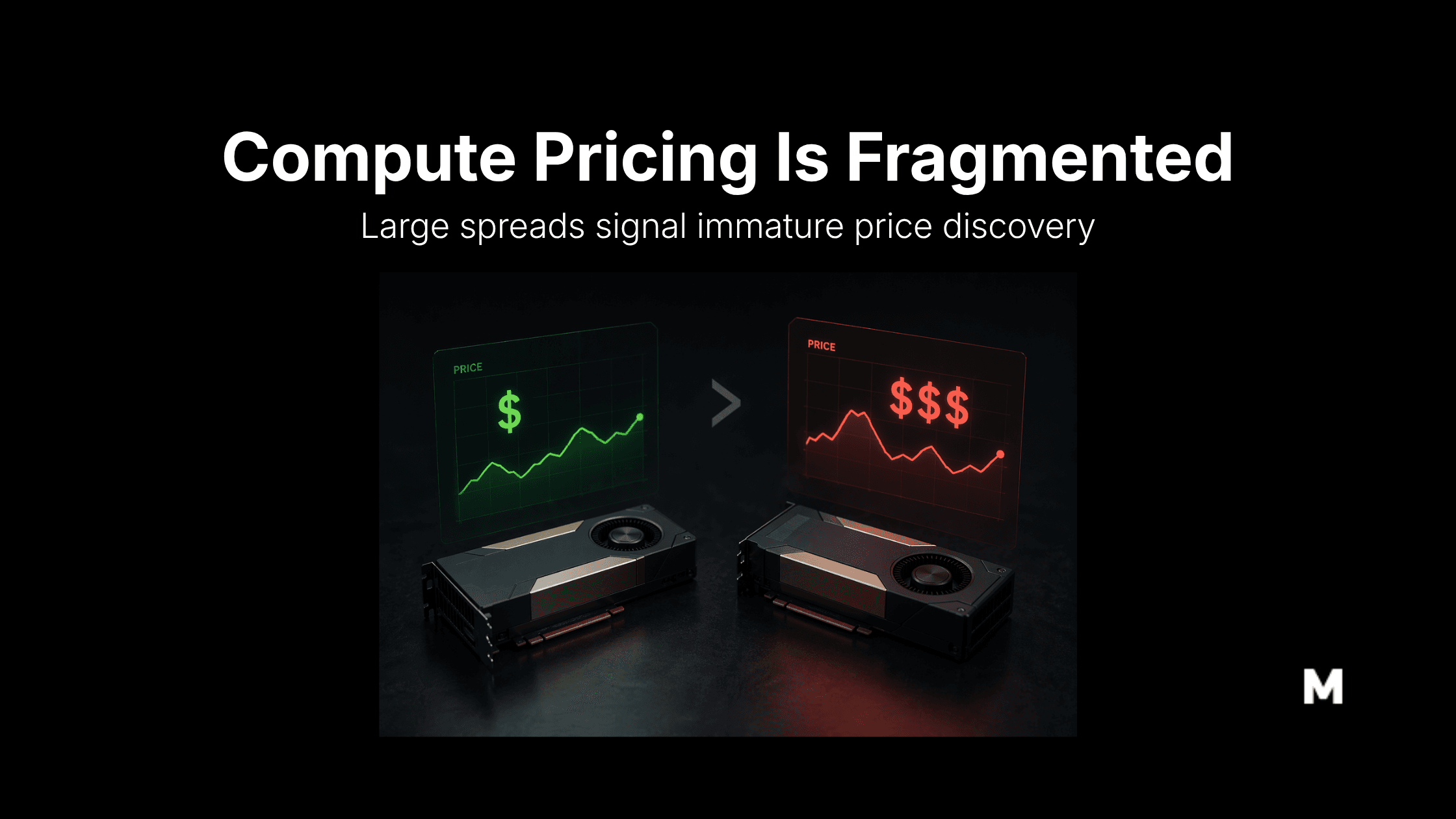
Two GPU cloud providers serve the exact same NVIDIA H100 SXM5. Same silicon. Same FP8 throughput. Same 80GB HBM3. Same NVLink fabric. One charges $1.99/hour. The other charges $5.00/hour.
The 2.5× spread isn’t a market inefficiency that will resolve next quarter. It’s a structural feature of how AI compute is sold today — and the gap is wider in 2026 than it was two years ago.
This article explains why the spread exists, where the cost differences actually come from, and what it tells you about the underlying market structure. The short answer: the premium isn’t infrastructure cost; it’s sales overhead, margin expectations, and the absence of any public market that would let buyers and sellers find each other efficiently.
TL;DR
- The hardware itself costs roughly the same at every provider. NVIDIA wholesales H100 SXM5 for similar OEM pricing across customers.
- Hyperscalers’ premium is mostly sales overhead and margin, not infrastructure cost. They actually have lower per-kW power and colocation costs than long-tail providers.
- Long-tail providers price aggressively because they have to — no enterprise sales motion, no shareholder margin demands, growth-stage business model.
- The spread persists because there’s no transparent market where buyers can easily compare and route. AI compute is a directional product, not a marketized commodity.
- For buyers: shopping providers is the single largest cost lever. Routinely 40–60% savings.
The four-tier provider landscape (and what each tier actually charges)
Cloud GPU providers fall into four pricing tiers, with very different cost structures:
| Tier | H100 SXM5 on-demand $/hr (2026) | Examples |
|---|---|---|
| Hyperscaler | $3.50 – $5.00 | AWS p5, Azure ND H100 v5, GCP A3 |
| Specialty | $2.50 – $3.50 | CoreWeave, Lambda, RunPod |
| Long-tail | $1.99 – $2.50 | DataCrunch, Vultr, Hetzner, regional providers |
| Decentralized | $1.50 – $2.50 | Akash, Bittensor subnets, io.net |
The 2.5× spread holds across most modern GPU SKUs (A100, H100, H200, and emerging Blackwell). For full pricing data: Mercatus GPU Index. For the broader pricing landscape framework: Cloud GPU Pricing.
But raw pricing comparison doesn’t explain why the same hardware costs 2.5× more from one provider than another. The answer is in the cost structure.
Where the cost differences actually come from
A breakdown of where each $/GPU-hour goes at the long-tail tier vs hyperscalers:
| Cost component | Long-tail provider | Hyperscaler |
|---|---|---|
| Hardware amortization (3yr, 75% util) | $0.55 | $0.55 |
| Power | $0.10 – $0.25 | $0.10 – $0.20 |
| Colocation | $0.08 – $0.15 | $0.05 – $0.10 |
| Networking + storage | $0.05 – $0.10 | $0.10 – $0.20 |
| Ops + customer support | $0.05 – $0.15 | $0.30 – $0.60 |
| Sales + marketing overhead | $0.05 – $0.10 | $0.50 – $1.00 |
| Margin | $0.20 – $0.50 | $1.00 – $2.00 |
| Total $/hour | $1.99 – $2.50 | $3.50 – $5.00 |
Three observations destroy the conventional “you pay more for better infrastructure” narrative:
1. Hardware costs are essentially identical across tiers
NVIDIA sells H100 SXM5 to OEMs at similar wholesale prices. Volume discounts vary slightly (hyperscalers get marginally better terms on multi-thousand-unit orders), but the practical hardware capex is within 10% across all serious providers. Any provider amortizing $33K of hardware over 3 years at 75% utilization arrives at roughly the same $0.55/hour hardware line.
2. Hyperscaler power and colocation costs are
lower
, not higher
This surprises people. Hyperscalers operate at scales (megawatt-class facilities, custom datacenter design, regional power purchase agreements) that give them per-kW costs below what most specialty and long-tail providers achieve. AWS, Google, and Microsoft all run datacenters with PUE around 1.1, vs the industry average of 1.5. Their power and colocation lines are genuinely cheaper than the smaller providers’.
3. The hyperscaler premium is sales motion and margin
The $1.50–$3.00/GPU-hour gap between hyperscalers and long-tail providers reflects:
- Enterprise sales infrastructure — account managers, solutions engineers, contract negotiators. Real money.
- Shareholder margin expectations — public companies need ~30–40% gross margin on cloud services. Long-tail providers operate at single-digit margins, sometimes lower while growing.
- Brand premium — enterprise procurement teams trust AWS/Azure/GCP. The trust has real economic value.
This is not a moral judgment. Hyperscalers genuinely deliver value for enterprise customers with bundled services, compliance certifications, and contractual reliability. But that value is not “we have better infrastructure than the long-tail provider.” It’s “we have a sales motion, support tier, and ecosystem that justifies the premium for some buyers.”
For buyers without those specific needs, the premium is pure cost without value.
Why long-tail providers can run leaner
The long-tail tier — DataCrunch, Vultr, Hetzner, dozens of regional operators — runs at $1.99–$2.50/GPU-hour because their cost structure is fundamentally different:
- Smaller sales teams (often founder-led, often product-led growth)
- Lower margin tolerance (private companies optimizing for growth, not quarterly earnings)
- Regional cost advantages (cheaper power, cheaper real estate, cheaper labor)
- Less ecosystem overhead (you get GPUs, not a comprehensive cloud platform)
This isn’t an unsustainable model. Long-tail providers consistently grow revenue and serve real production workloads. They’re not running below cost; they’re running with a different cost structure that produces a lower effective price for the same hardware.
For buyers willing to accept the tradeoffs (less brand recognition, fewer bundled services, smaller sales support), long-tail providers deliver dramatic savings. For institutional procurement teams reflexively defaulting to hyperscalers, they’re the single largest unrealized cost optimization.
For ranked comparison of the cheapest providers: Cheapest GPU Cloud Providers.
Why the gap persists (and probably widens)
If the spread is real and the savings are dramatic, why doesn’t market pressure compress it?
The answer is structural: there’s no transparent market for cloud GPU compute. Buyers and sellers can’t find each other efficiently. Specifically:
Discovery is hard. Most buyers don’t know long-tail providers exist. Procurement defaults to hyperscalers because that’s what the team has heard of.
Comparison is hard. Pricing pages have inconsistent units, hidden fees, opaque commitment terms. Apples-to-apples comparison requires deliberate work.
Switching is hard. Per-provider integration overhead (different APIs, different auth, different orchestration) makes provider portability genuinely costly.
No central price discovery. There’s no exchange where cleared prices are visible to everyone. Each provider lists its prices independently; the market doesn’t aggregate them.
These four frictions add up to a market that’s structurally inefficient. Hyperscalers can charge premium prices not because their hardware is better, but because the market doesn’t make their alternatives visible to most buyers.
This is exactly the kind of inefficiency that opens up when commodity markets mature. Oil prices used to vary 30%+ across negotiated bilateral contracts before the NYMEX crude futures market opened in 1983. Electricity prices used to vary 30%+ before regional spot markets opened in the 1990s. AI compute is walking the same path.
For the full thesis on why this is changing: The Open AI Compute Economy.
What this means for buyers
Practical implications:
Always shop providers
Get quotes from at least one provider in each tier (one hyperscaler, one specialty, one long-tail in your region). The savings are real and the comparison cost is low.
Compare on real cost, not headline rate
The published $/GPU-hour is roughly 60–70% of total cloud bill. Egress, storage, support tier, and management overhead add the rest. Long-tail providers often have minimal egress charges and fewer hidden fees, compounding their pricing advantage.
Understand what you’re actually paying for at the higher tier
If you’re paying hyperscaler premium prices, articulate why. Ecosystem integration with S3 + Lambda? Existing enterprise spend commitment? Compliance attestations you specifically need? Each of these can justify the premium for the right buyer. “We always use AWS” is not a justification.
Use Mercatus Spot Market for unified routing
Rather than committing to a single provider, Mercatus Spot Market abstracts the provider-shopping problem: a unified API endpoint that routes across 22+ providers from all tiers. Average effective price is 8.2% better than going direct to any single provider. For inference workloads, this is the operational answer to the cross-provider pricing problem — you get optionality across the entire provider ecosystem from a single integration.
What this means for the market
The same problem this article describes for GPU pricing — opaque cross-provider variance, no transparent clearing, frictional discovery — applies even more strongly to token-level pricing.
When you pay $5/1M tokens for GPT-4o or $0.14/1M for DeepSeek V3, those prices reflect: the underlying GPU economics described above, plus provider markup, plus the same market-structure inefficiencies. The 30% cross-provider spread for the same H100 hardware translates directly into 30%+ cross-provider spread for the same model’s per-token price.
The fix is the same in both cases: open market infrastructure. Public clearing prices, open seller participation, transparent quality signals, standardized contracts. This is what Mercatus is building — first for tokens (Spot Market is live), eventually for GPU compute as well.
For the full thesis: The Open AI Compute Economy. The argument that started with “why do GPU prices differ 30%?” lands at “this is what every commodity market goes through before it opens up — and AI compute is doing it in months, not decades.”
Frequently Asked Questions
Why is the same H100 priced 2.5× different across cloud providers?
The hardware itself costs all providers roughly the same. The 2.5× spread reflects sales overhead and margin structures, not infrastructure cost. Hyperscalers carry expensive enterprise sales motions and high shareholder-driven margin expectations. Long-tail providers run leaner and accept lower margins for growth.
Are long-tail GPU providers reliable?
It varies. The best long-tail providers (DataCrunch, Vultr, Hetzner, several regional operators) match specialty-tier reliability while pricing 30–50% below them. The worst aren’t suitable for production. Vetting matters. Mercatus GPU Index tracks reliability metrics alongside pricing.
Why don’t market forces compress the cross-provider price spread?
Because there’s no transparent market. Buyers can’t easily discover, compare, and route to alternative providers. Switching costs are real. Procurement defaults are sticky. The spread is a feature of the closed market structure, and it persists until open market infrastructure makes alternatives visible.
How can I find the cheapest provider for my workload?
Mercatus GPU Index tracks live cross-provider pricing across 22+ providers. For inference workloads, Mercatus Spot Market routes automatically across providers — you get the cross-provider price advantage without per-provider integration.
Are hyperscalers ever worth the premium?
Yes, in three scenarios: existing cloud commitments, compliance certifications, or deep ecosystem integration with bundled services. Outside these specific cases, hyperscaler GPU on-demand pricing is structurally non-competitive.
Will the 30%+ spread eventually narrow?
Probably yes — but slowly, and only through changes in market structure (open marketplaces, transparent price discovery, lower switching costs). Not through hyperscalers cutting prices. The premium is structural to their business model.
Does this same pricing dynamic apply to LLM API tokens?
Yes — even more strongly. The cross-provider spread for the same model’s per-token price often exceeds 30%, driven by the same underlying GPU economics plus markup variance. The market-structure fix is the same: open marketplaces with transparent clearing. See The Open AI Compute Economy.
Methodology
Pricing data sourced from Mercatus GPU Index, May 2026 cross-provider snapshot. Cost component breakdowns for hyperscaler vs long-tail providers reflect industry analysis of public financial data and Mercatus’s own provider relationship data. Last verified: 2026-05-04.